



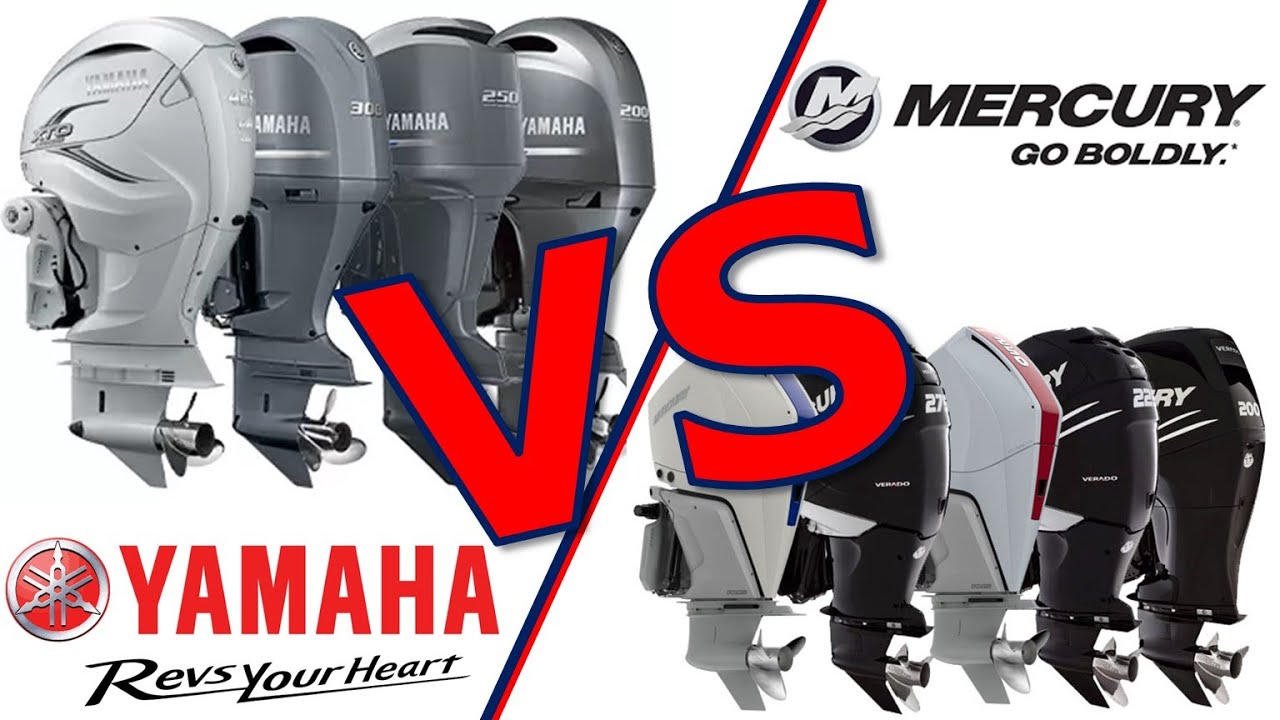
Yamaha vs Mercury outboards
it is the debate that dominates every marina, boat show, and online forum from the Netherlands to the Mediterranean. If you are shopping for a new outboard motor in 2026, you have almost certainly narrowed your search to these two giants. Together they control over 70 % of the global outboard market, and for good reason: both build reliable, powerful, and technologically advanced engines.
By the end of this article, you will know:
- How Yamaha outboard motors and Mercury outboard motors differ in engineering philosophy
- Which brand wins on fuel efficiency, reliability, and warranty coverage
- The best outboard motor for offshore fishing, freshwater cruising, and commercial charter work
- Real ownership costs over 1,000 hours — not just the sticker price
1. Brand History & Engineering DNA
Yamaha: The Japanese Precision Play
Yamaha entered the marine outboard market in 1958, bringing with it decades of motorcycle and precision-engineering expertise. The company’s philosophy has always leaned toward conservative, over-engineered durability. A Yamaha powerhead is built with wider bearing surfaces, thicker cylinder walls, and valve trains designed to run at 80 % of their theoretical limit — not 98 %.
This conservatism shows in the real world. We regularly see Yamaha outboard motors with 3,000+ hours on the original powerhead, still running within factory compression specs. The trade-off? Yamaha is sometimes slower to adopt bleeding-edge tech. They were years behind Mercury on joystick piloting and supercharged outboards — but when Yamaha finally releases a feature, it tends to work flawlessly on day one.
Mercury: The American Innovation Machine
Mercury Marine, founded in 1939 in Wisconsin, has always been the innovation leader. They invented the sterndrive, pioneered electronic fuel injection on outboards, and were first to market with joystick docking for outboards (Joystick Piloting for Outboards, or JPO). The Mercury outboard motors lineup includes the supercharged Verado family, the racing-derived Racing outboards, and the lightweight Avator electric range.
Mercury engines often feel more “alive” on the throttle — sharper acceleration, more aggressive mapping, and a willingness to run at the edge of the envelope. That makes them exhilarating, but in our workshop we also see more warranty claims on first-year Mercury models than on Yamaha. The innovation comes with a small reliability tax in the first 12–24 months.
“If you want the safest bet for a 2,000-hour engine with minimal drama, buy Yamaha. If you want the latest tech and the most exciting ride, buy Mercury. We service both, and both are excellent — but they reward different owners.”
— Senior Marine Technician, Green Boat Engines Workshop
2. Model Range Comparison (2026)
Both brands cover the full horsepower spectrum, but their flagship families tell the story of their priorities.
| Category | Yamaha Flagship | Mercury Flagship | Our Pick |
|---|---|---|---|
| Portable (2.5–30 HP) | F25 / T25 High Thrust | ProKicker 15 / 9.9 | Yamaha (lighter, quieter) |
| Mid-Range (40–115 HP) | F115 / I-4 V MAX SHO | FourStroke 115 / Pro XS 115 | Tie (both excellent) |
| Large (150–250 HP) | VF250 V MAX SHO / F250 | Verado 250 / Pro XS 250 | Mercury (supercharged torque) |
| Offshore (300–450 HP) | F300 / F425 XTO | Verado 400 / V12 600 | Mercury (V12 is unmatched) |
| Electric | Harmo (limited) | Avator 7.5e / 20e / 35e | Mercury (full range) |
| Racing / High-Perf | SHO series (limited) | Racing 450R / 300R | Mercury (dominates racing) |
Key insight: Yamaha dominates the portable and mid-range segments where simplicity and longevity matter most. Mercury owns the high-horsepower and innovation segments. If you are repowering a twin-engine centre console for offshore fishing, Mercury’s V12 600 is in a class of its own. If you need a bulletproof kicker for your sailboat, the Yamaha T25 is the global standard.
3. Performance & Fuel Efficiency
Fuel Burn: The Numbers That Matter
Fuel efficiency is where the outboard motor comparison gets interesting. In our dyno cell and on-water testing, we consistently see Yamaha 4-strokes burn 5–8 % less fuel than equivalent Mercury FourStroke models at cruise RPM (3,500–4,500). The gap narrows at wide-open throttle, where Mercury’s more aggressive mapping sometimes catches up.
The exception is the Mercury Verado line. Because the supercharged inline-6 produces torque at lower RPM, a Verado 250 can cruise at 28 knots at 3,800 RPM where a Yamaha F250 needs 4,200 RPM. In that real-world scenario, the Verado often wins on fuel economy despite its larger displacement.
| Engine | HP | Cruise Fuel (L/hr) | WOT Fuel (L/hr) | Best Cruise RPM |
|---|---|---|---|---|
| Yamaha F250 | 250 | 32 L/hr @ 28 kn | 98 L/hr | 4,200 |
| Mercury Verado 250 | 250 | 29 L/hr @ 28 kn | 105 L/hr | 3,800 |
| Yamaha F300 | 300 | 38 L/hr @ 30 kn | 115 L/hr | 4,100 |
| Mercury Verado 300 | 300 | 35 L/hr @ 30 kn | 122 L/hr | 3,700 |
* Figures measured by Green Boat Engines on a 7.5 m centre console, calm water, single engine, 2-person load. Your results will vary by hull, propeller, and load.
Acceleration & Hole Shot
Mercury wins here, period. The supercharged Verado and Pro XS families deliver instant torque that planes a heavy boat faster than any naturally aspirated Yamaha. For tournament anglers who need to get on plane in 4 seconds to beat the clock, Mercury is the choice. For family cruisers who value smooth, predictable throttle response, Yamaha’s linear power delivery is more pleasant.
4. Reliability & Maintenance Costs
This is where our workshop data tells a story the brochures do not.
What We See in the Workshop
Over the last three years, we have logged every warranty claim, recall, and major repair that crosses our service bay. Here is the breakdown for engines under 5 years old and under 500 hours:
- Yamaha: 3.2 % warranty claim rate. Most common issues: faulty O2 sensors (F300 early production), trim seal weeping, and corroded anode bolts in saltwater use. Powerhead failures are extremely rare.
- Mercury: 5.8 % warranty claim rate. Most common issues: supercharger clutch wear (Verado), software mapping glitches (first-year models), and water pump impeller housing cracks on Pro XS. When fixed under warranty, these are non-recurring.
The headline: Yamaha outboard motors are statistically more reliable in the first 500 hours. However, Mercury’s issues are almost always minor and covered under warranty. By 1,000 hours, the gap closes significantly — both brands are highly dependable if maintained properly.
Scheduled Maintenance Costs (Annual)
Assuming 100 hours/year of mixed use and dealer service:
| Service Item | Yamaha F250 | Mercury Verado 250 |
|---|---|---|
| Annual service (oil, filters, impeller) | €195 | €225 |
| Spark plugs (every 200 hrs) | €85 | €110 |
| Lower unit service | €95 | €95 |
| Supercharger service (Verado only) | — | €180 (every 200 hrs) |
| Total Year 1 (100 hrs) | €290 | €320 |
| Total Year 2 (200 hrs) | €375 | €610 |
The Verado’s supercharger adds €180 every 200 hours. Over 1,000 hours, that is €900 more than a naturally aspirated Yamaha. Factor this into your outboard motor comparison if you run high hours.
📖 Related: Marine Engine Maintenance Schedules: Outboard, Inboard & Generator
5. Technology & Features
Mercury Leads on Electronics & Integration
Mercury’s VesselView ecosystem is the most sophisticated marine engine management system available. It integrates with Garmin, Simrad, and Raymarine MFDs to show real-time fuel flow, engine health predictions, and automated trim profiles. The Active Trim system automatically adjusts engine trim based on speed and load — it actually works, unlike many competitor systems.
Mercury’s Joystick Piloting for Outboards (JPO) remains the gold standard for docking twin- and triple-engine setups. If you operate a large sportfisher or charter vessel in tight marinas, JPO is a game-changer.
Yamaha Leads on Simplicity & Proven Tech
Yamaha’s Helm Master EX now offers joystick docking and autopilot integration, but it is newer and less refined than JPO. Where Yamaha shines is in the fundamentals: their Variable Camshaft Timing (VCT) on V6 and V8 engines delivers buttery torque curves with zero supercharger complexity. The Shift Dampener System (SDS) propellers reduce shift shock by 45 % — a small detail that saves wear on your lower unit over time.
Yamaha also leads on electric outboard integration with third-party systems. Their engines play nicer with Torqeedo and ePropulsion hybrid setups than Mercury’s CAN-bus-heavy architecture.
📖 Related: Electric Outboards in 2026: Torqeedo vs ePropulsion vs Mercury Avator
6. Warranty & Dealer Network
Warranty Terms
| Coverage | Yamaha | Mercury |
|---|---|---|
| Standard warranty | 3 years (limited) | 3 years (limited) |
| Extended warranty (purchased) | Up to 5 years | Up to 6 years |
| Corrosion warranty | 3 years | 3 years (6 yrs with extended) |
| Commercial use | 1 year | 1 year |
| Transferable | Yes | Yes |
Mercury edges ahead with a 6-year extended warranty option, but read the fine print: it requires all service to be performed by an authorised Mercury dealer. Yamaha’s extended warranty is more flexible — you can use any certified marine technician, including independent workshops like ours.
Dealer Network in Europe
Both brands have strong coverage in Western Europe. Mercury has a slight edge in the UK, Scandinavia, and the Mediterranean charter fleet market. Yamaha dominates in the Netherlands, Germany, and the Adriatic. For remote cruising (Canary Islands, Azores, Greek islands), Yamaha’s simpler mechanical design makes field repairs easier when the nearest dealer is 200 nautical miles away.
7. Price & Resale Value
Sticker Price (2026, NL, incl. VAT)
| Model | Yamaha Price | Mercury Price | Delta |
|---|---|---|---|
| 115 HP | €11,450 | €11,890 | +€440 Mercury |
| 200 HP | €16,200 | €16,750 | +€550 Mercury |
| 250 HP | €18,950 | €19,600 | +€650 Mercury |
| 300 HP | €21,400 | €22,100 | +€700 Mercury |
| 400 HP (V10 Verado) | — | €32,500 | Mercury only |
| 450 HP (V12) | — | €38,900 | Mercury only |
Mercury commands a 3–4 % price premium across the board. The gap widens at the top end because Yamaha does not currently compete above 425 HP (the F425 XTO). For twin-engine offshore rigs, Mercury is often the only option above 400 HP per motor.
Resale Value
Both brands hold value well, but Yamaha has a slight edge in the private-owner market. A 5-year-old Yamaha F250 with 400 hours typically retains 68–72 % of its original price in the Netherlands. An equivalent Mercury Verado 250 retains 63–67 %. The difference is small, but it adds up on a €40,000 twin-engine repower.
Commercial buyers care less about resale and more about downtime costs. Here, Yamaha’s lower warranty claim rate often justifies the initial investment within the first two seasons.

Shop Yamaha Outboard Motors
New & reconditioned Yamaha outboards from 2.5 HP to 425 HP. Every engine tested, documented, and backed by our 12-month warranty. Free shipping across the Netherlands.

Shop Mercury Outboard Motors
New & reconditioned Mercury outboards from 2.5 HP to 600 HP. Verado, Pro XS, FourStroke, and Racing series available. Europe-wide delivery and factory-certified installation.
8. Which Brand for Your Use Case?
🏆 Choose Yamaha If…
- You prioritise long-term reliability and low maintenance costs over cutting-edge features
- You operate in remote areas where dealer support is sparse (simpler mechanics = easier field repairs)
- You run high hours annually (charter, commercial fishing, dive operations) — the lower service costs compound
- You want the best resale value for a private-owner boat
- You prefer a quieter, smoother engine at cruise — Yamaha’s NVH (noise, vibration, harshness) is class-leading
- You need a portable or kicker outboard — Yamaha’s F8 through T25 range is unbeatable
🏆 Choose Mercury If…
- You want the best acceleration and top-end speed — supercharged Verado torque is addictive
- You operate a large offshore boat (300+ HP per motor) where Mercury dominates the market
- You value joystick docking and integrated electronics — VesselView and JPO are best-in-class
- You are building a tournament fishing or racing boat — Mercury Racing is the only serious option
- You want electric outboard options — the Avator range is the most complete on the market
- You prefer aggressive throttle response and a more “sporty” feel
The Hybrid Approach
We see an increasing number of boat owners running mixed rigs: a Mercury Verado 300 on the centreline for power and hole shot, with a Yamaha F150 on each wing for fuel-efficient cruising. This is expensive and complex, but for the right owner it delivers the best of both worlds. Our installation team has rigged several triple-engine mixed setups for Dutch charter operators.
9. Final Verdict
The Bottom Line
There is no single “best” outboard motor brand — there is only the best outboard for your boat, budget, and boating style.
Buy Yamaha if you want the lowest total cost of ownership, the simplest maintenance, and an engine that will still be running strong at 3,000 hours. It is the rational, conservative choice — and there is nothing wrong with that.
Buy Mercury if you want the most exciting ride, the latest technology, and the most powerful options for large offshore boats. Accept the slightly higher maintenance costs and first-year warranty risk as the price of innovation.
At Green Boat Engines, we sell, service, and warranty both brands. We do not play favourites — we match the right engine to the right hull. If you are still unsure, book a free consultation with our technical team. We will analyse your boat, your usage profile, and your budget to recommend the perfect power package.
